
Timmer
Jurrien Timmer, Director of Global Macro at Fidelity Investments. He is an excellent chef as it happens, I think I’ve shared some of his culinary creations before. I’m often more interested in what he’s been cooking than what he has to say about some arcane part of the global economy, so perhaps you are too?
Marc Andreessen once pointed out that the best people in particular roles are excellent at more than one thing. So the best CFO might be a good CFO and an excellent communicator. The best marketeer might be highly competent at marketing but also a very talented software engineer. It is the multi-domain expertise that is actually sought after. Does it apply to cooking and investing? I’m open to thinking it might.

I must say, I appreciate the attention to detail. The herbs, enough but not too much olive oil. With his hunger assuaged, and ours activated, he turned his mind to macro matters.
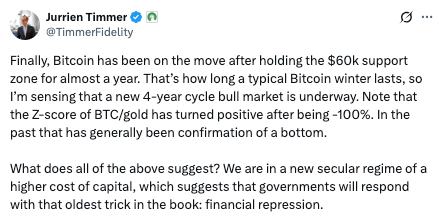
Financial repression. “The oldest trick in the book”. We are seeing it everywhere and I think we’ll get a very good example in the UK next month and in Australia in the next few years.
Rumours abound in London that the new Prime Minister is going to put taxes up, a lot. My estimate would be that capital gains tax will rise significantly, perhaps the ‘mansion tax’ too (read normal family home). That itself is not really financial repression; what will happen in response to Burnham’s taxes is that receipts will fall even further. It will pay simply not to make the capital gain and not to buy the house that comes with the additional tax burden. With the economy plunged into the fiscal abyss, the government will have no choice but to inflate away their debts, and they will. Far better to do it when ‘it has to be done, we have no choice’ than when perhaps there are other, albeit unpleasant choices.
The repression will come with the IMF loans, which the UK and France are not that far away from. The UK last turned to the IMF in 1976. Debt/GDP was 50% then compared to 100% now. That was not the issue, it was the current deficit that ran at 10% per annum in the late 70s. Today the annual deficit is 4.3% of GDP but for that to double, UK tax receipts only need to fall by 11%. That might sound unlikely but over the course of a couple of years it is quite possible. What is almost impossible is that government spending falls, it’s almost entirely structural now.
So, from my point of view, I don’t know that bitcoin is reflecting some ‘4 year cycle’ or whether the policy of spending money we simply don’t have is finally having its effect. There may well be a view from investors that “I’ll buy a bit just in case and leave it at that.” Arguably, a reasonable strategy because dramatic action is coming at some point that will destroy bondholder and currency holder value.
Fantastical? Maybe, but things can happen and do happen, you know.
Does David Deutsch read MoneyBits?

Those of you who read along last week will enjoy this. David Deutsch taking Terence Tao to task. Not many people could.
To be fair, in this video Tao makes the point that maths teaches, amongst other things, that systems are anything but stable. They can be stable for a long time before they go absolutely nuts, the implication being this could well happen with AI, which is simply a mathematical system. Deutsch, firmly in the camp of ‘so what?’.
The ‘we must slow down’ crowd are, in my view, the enemies of knowledge. Anthony Albanese, one such person, is in America at this very moment making the case for his “digital duty of care”. This is in fact a gatekeeping system for what can and cannot be shared, as far as opinion, information or, indeed, knowledge is concerned. America, to its credit, did not pull its punches:
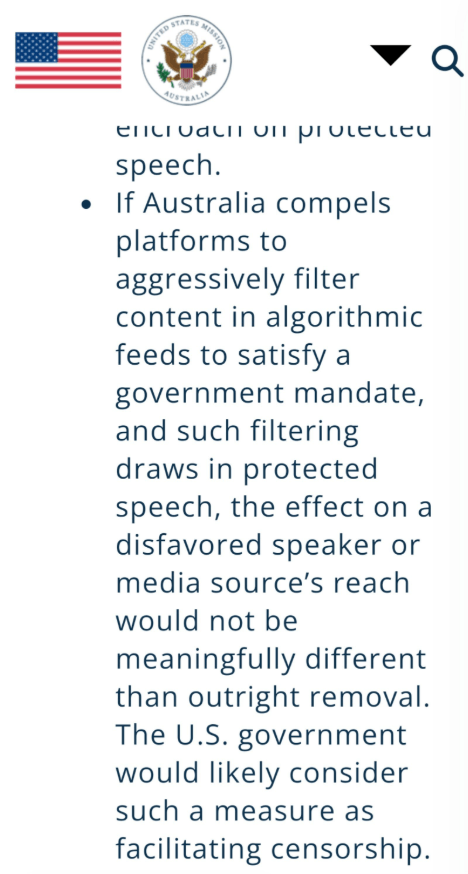
My bet, Albanese presses ahead and Australia will have its walled garden, at enormous cost.
Ch44n3l s7vn
Channel 7, reporting for duty as Sydney property prices continue to ‘flatline’. Interesting analysis. Apparently new data is showing us something not previously known.
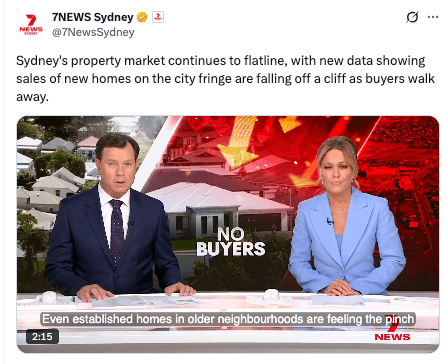
The editorial choices are interesting. Tell people that house prices are dropping a lot and they might switch off the television, nobody wants to know that, so better to say something else. A euphemism, ‘flatlining’. House prices in Sydney are flat this week, presumably against last week’s price, in which case yes, the data is new.
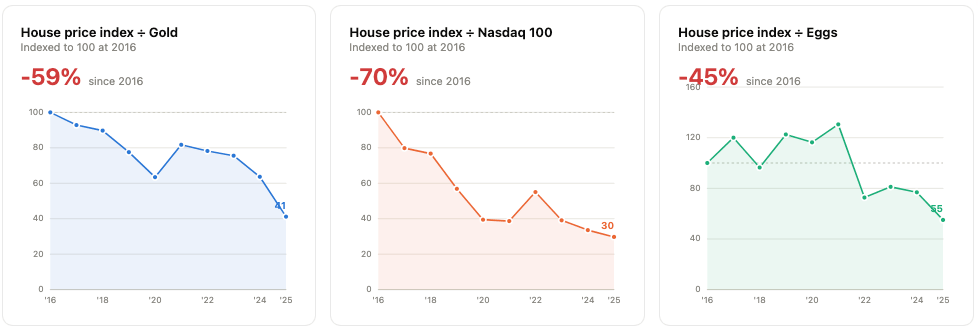
It’s quite straightforward to check for yourself how they are going though. Over the last decade they are down 59% versus gold, 70% versus the Nasdaq 100 and 45% against eggs (my favourite measure). Again, eggs are a favourite because hens never really get better at laying eggs, productivity is kind of possible but not in any significant way.
And I know, yeah but, but. Well, choose something super boring. My favourite choice is a company in Europe, Linde Plc. A big industrial company, they own BOC Gases, basically track the economy with how they are going. Nothing is more boring (and excellent) than Linde.
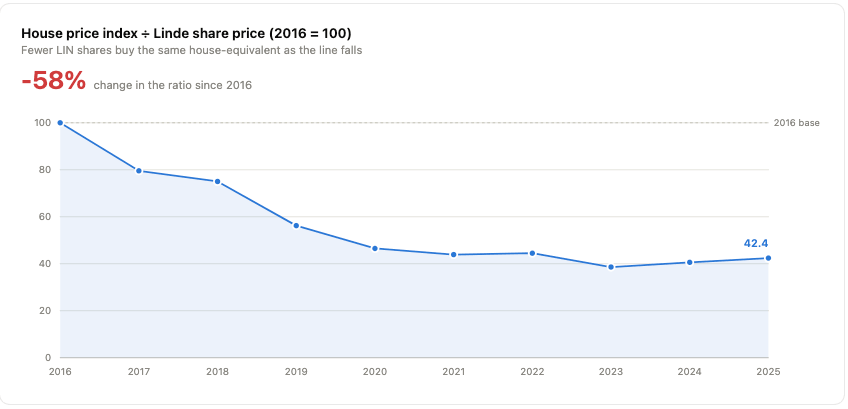
I can’t really say it in enough different ways. “It’s WAGES that are collapsing”. The fact that houses are relatively cheaper but still out of reach for many is solely for that reason. That’s why you feel the way you feel and if you don’t believe me, it is now a trivial matter to run these charts for yourself in Gemini or GPT or whatever you use. Pick one, check it with the other.
(Incidentally, on methodology, the house price index is ‘real’, so it was converted back to nominal using Australian CPI before making the comparisons above.)
Down, though, does not win elections. Down, does not mean strong banks. Down does not mean a strong economy. So we say something else. We say flatlining.
As adjectives go though, flatlining would not be the one I would have chosen. Perhaps because I watched too much ER when I was younger. My personal conclusion is that house prices are down about 50% in 10 years. In a population of 27 million, almost nobody would believe that to be true though.
You could use this prompt: it returns a slightly more interesting view versus per head cattle prices. Again something that doesn’t really jump about with productivity so might be slightly more meaningful. Conclusion is down 40% but it’s mostly quite recent.
{I want to compare Australian house prices against cattle prices per head, from 2016 to the most recent full year available, as an interactive HTML chart. I don’t have a data file — please source both series yourself:
1. Australian house prices: find an annual Australian house price index (e.g. a real house price index, 2010 or similar base year) covering 2016 onward. Adjust it for CPI.
2. Cattle price per head: there’s no single clean public “$/head” series for beef cattle, so derive one — use USDA NASS’s annual “Meat Animals: Production, Disposition, and Income” reports (US cash receipts from cattle & calves marketings ÷ total head marketed) as a national average value per head, for as many years as you can source cleanly from official reports. This will be a US-dollar, US-national-average figure, not Australian or breed/market-specific — that’s expected, just be explicit about it in the chart.}
The beginning
The Clarity Act failed in the US. Still, up stepped the SEC to fill the void and issued a five year ‘innovation exemption’ for tokenised stocks. It is a distinctly non-trivial step because we will likely see an explosion of issuance in this area now. Should it be popular, it will likely be the template of what Clarity will ultimately become.
What then, is the difference between holding a stock as a token and holding it on, say CHESS? Well, first of all swapping Tesla for Microsoft stock, can happen directly. So I can quote and exchange for any asset in terms of any other asset because they are now divisible into sub-units. I don’t really need to go in and out of cash. It makes a huge difference for liquidity and settlement T+2 goes away, it’s instant. That’s just one example, but it is materially better and I expect it to be enormously popular. 24/7 trade is the next step, for sure it’s coming.
Next (unbelievably) the European Central Bank launched their own tokenised platform known as ‘Pontes’. This is for settlement between banks and the central bank rather than for retail users, but nonetheless it is a step forward. ‘Tokenised asset transactions’, from Christine Lagarde……well I never.
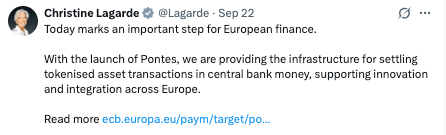
I suspect this will be the beginning of a very large wave of tokenisation of securities in America and a very slow follow from Europe.
If you were wondering why Bitcoin jumped straight to $85k and beyond. This was why and so it should.
Euro-Trash

France now has a credit rating of A+. I was surprised there was anything better, at school A+ was the pinnacle of academic achievement. Congratulations then, to France.
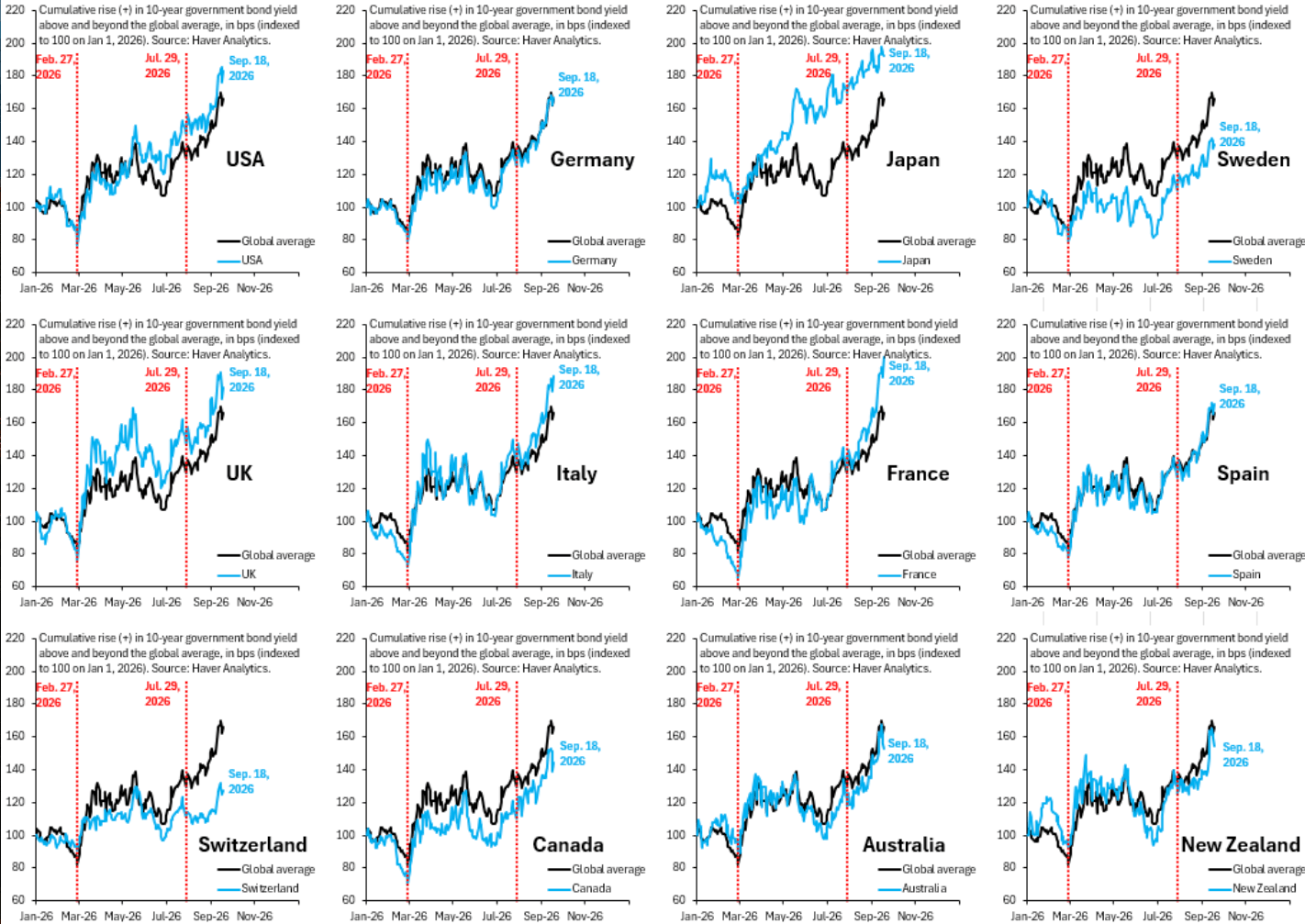
It’s not France though is it really. It’s everywhere. It’s just that the rating agency has had the time to tell France and they don’t like upsetting all countries at once. The writing at the top of these charts says “The cumulative rise in government bond yields above and beyond the global average in basis points”. So, if the blue line gaps the black line, that’s bad. So France, USA and the UK. Conversely, Switzerland is cleaning up. Nothing new. These charts by the way are from Robin Brooks, if you’re a bond vigilante he’s very good.
For Europe though, only Germany matters and the winds of change are blowing hard from Berlin to Munich. In the German state elections this week the communist party (Die Linke) won in Berlin. Die Linke was formed from former East German political parties after reunification; they don’t specifically identify as communist but their signature policy includes the expropriation of over 200,000 housing units from large private landlords to tackle the city’s housing affordability crisis. It won’t actually happen (yet) but it was remarkably popular as a policy.
Further north, the far right parties were winning. The AfD won 38 per cent of the vote in Mecklenburg-Western Pomerania. Put in context, Chancellor Merz’s CDU had only 4.9% of the vote, leaving them with zero seats. We are seeing the total decimation of one of the most successful political parties in Europe.
Currently, German politics has an agreement known as the ‘Brandmauer’ (the firewall) that no party will form a coalition with the AfD. So, despite them being the largest party in many areas, they will not govern. Brandmauer was no big deal when the AfD had 3% or 7%, it’s a terrible look when they have 38% though.
We have seen this strategy deployed in France too. Recall Macron withdrew many of his party’s candidates to ensure the right-wing candidates lost elections across France that they would otherwise have won. It worked, it worked in Germany too but it won’t keep working. Voter frustration will simply grow as the political establishment attempts to maneuver around election results they don’t like.
We are witnessing the end of the European Union here. It’s early to call it but Germany will not continue paying for the rest of Europe forever. Why would they? Why should they?
We can tell from the bond market. There is absolutely no reason for French bond yields to gap German bond yields, unless one day those two markets have a different interest rate. The bond market says it’s a non-zero chance. German voters say it’s a non-zero chance. So do the French.
