
Silent payments
One of the main criticisms of bitcoin is, surprisingly, its lack of privacy. Assume I buy some bitcoin on an exchange, I provide my KYC documents and I send it to your address which houses some bitcoin you also bought on the exchange. It is a simple matter then to identify who sent the money and who received it. Worse than that, all our subsequent transactions we send from our addresses suffer the same ‘fate’ in that they can be traced back to the address with the KYC. In most cases, so what, but it is the antithesis of what bitcoin is about as far as sovereign economic transactions are concerned.
Silent payments break this link. A silent address allows you to generate a receive address that only you and the sender actually know, it is not visible on the blockchain at all. The bitcoin blockchain will register a transaction as usual. The amounts sent to and from will also be visible (we will see why) but the address itself will mean nothing. It will not tie to any other address or input/output making standard chain analysis much more difficult.
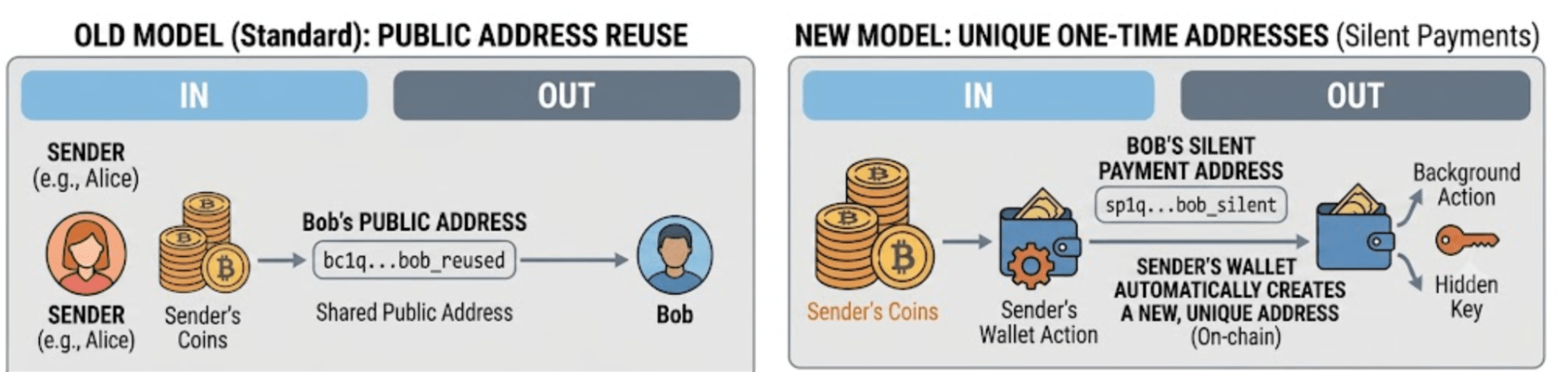
There is an additional burden on the sender and receiving wallets when using silent payments. On sending, the wallet must generate the new address and the receiver must search all transactions for matching receipts. It’s trivial for a computer but worth knowing because not all wallets are yet capable of handling this.
Why not go the full hog though? Hide everything, the amount, the addresses etc. This is technically possible but would massively curtail some other aspects of bitcoin. For example, if you run your own node you can query that node for the total amount of bitcoin supply. Your node will then compute the sum of all inputs and outputs that have ever taken place and will report back to you something in the order of 20.062m coins. If we were to mask the details of all transactions this would not be possible and so the key tenet of supply verification would be lost.
In essence, for bitcoin to work, we do not need to know with whom things happened, or between which addresses things happened. We only need to know that something happened.
You can read more here. Frankly, there isn’t much more to know. Bitcoin just got a lot better.
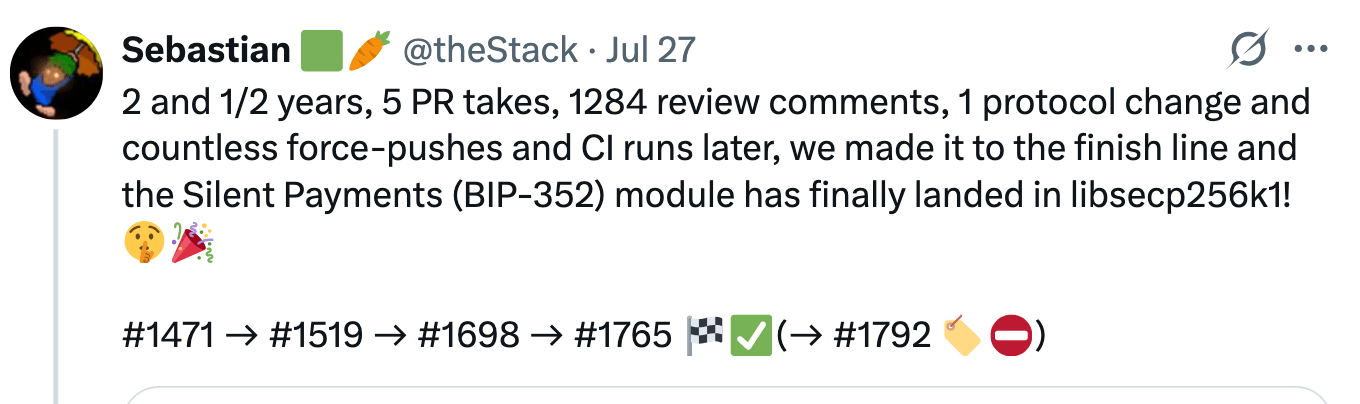
Silent payments are a significant step. Firstly they address a real issue, we have to continue to innovate and improve the bitcoin protocol because the world is moving forward at pace. You can use silent payments with a specific group of wallets now but it is not yet fully integrated into Bitcoin Core. Even so, the largest and most difficult part of that integration is done (as Sebastian reports above).
You will most likely hear about silent payments in a few years when they hit the mainstream. Exchanges will refuse to send to silent addresses, ‘Silent history’ will be queried. Then you will know. It’s working!
Obvious stuff, maybe
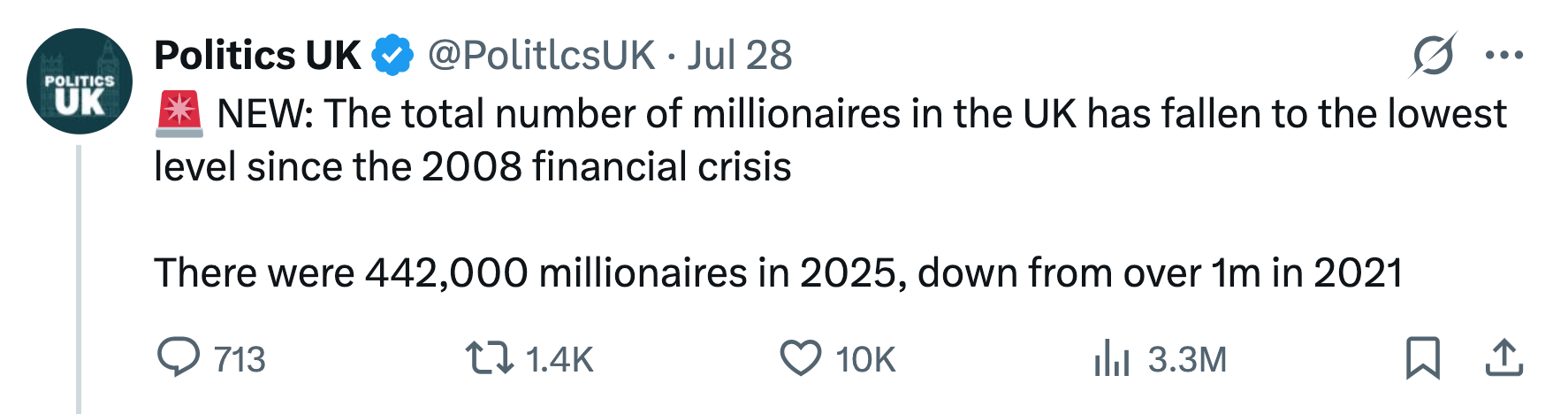
It would be possible, I think, to get quite depressed about the trajectory of some parts of the western world. The economic trend in the U.K, Europe and increasingly Australia, is frankly quite dark. A great deal of cope is being used to mask what is a slow motion car crash.
A further example this week, the closure of the UK’s largest radio telescope Jodrell Bank ‘All scientific observations at Jodrell are expected to cease on the 1 April 2028 unless alternative funding can be found.’ It’s particularly tragic because one of the driving forces behind it is energy costs which are eating the budget of the government agency which provides the funding.
Still, all things are opportunities for someone. If the UK doesn’t want to explore space, someone else will. If the western world wants to continue its regressive pattern of spending and population decline then we know exactly what will happen and can compute the opportunity.
We know with some confidence what happens because it happened in Japan. Japan has not collapsed and I don’t think the EU or the UK will either but something very similar to this could occur. Consider these charts; they are based on someone investing ¥100 in the allocation 60/20/20 in short, medium, and long term bonds. There is nothing exotic here, it’s an ok strategy. They simply hold to maturity and reinvest.
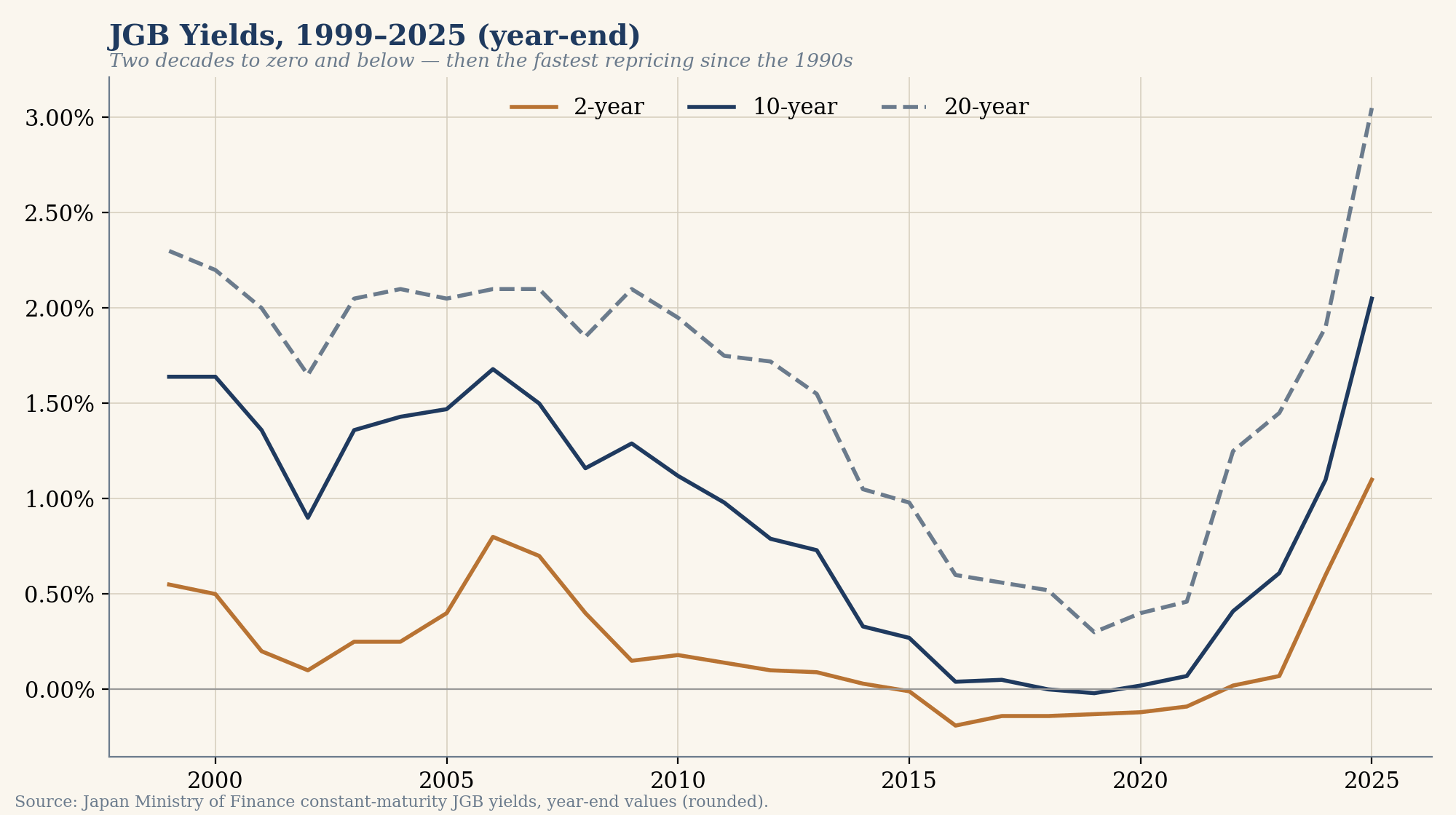
First, Japan borrows without limit, the central bank simply buys all the bonds. No alternatives exist. Interest rates remain low, but then as the bank approaches the limit of its powers, those rates surge.
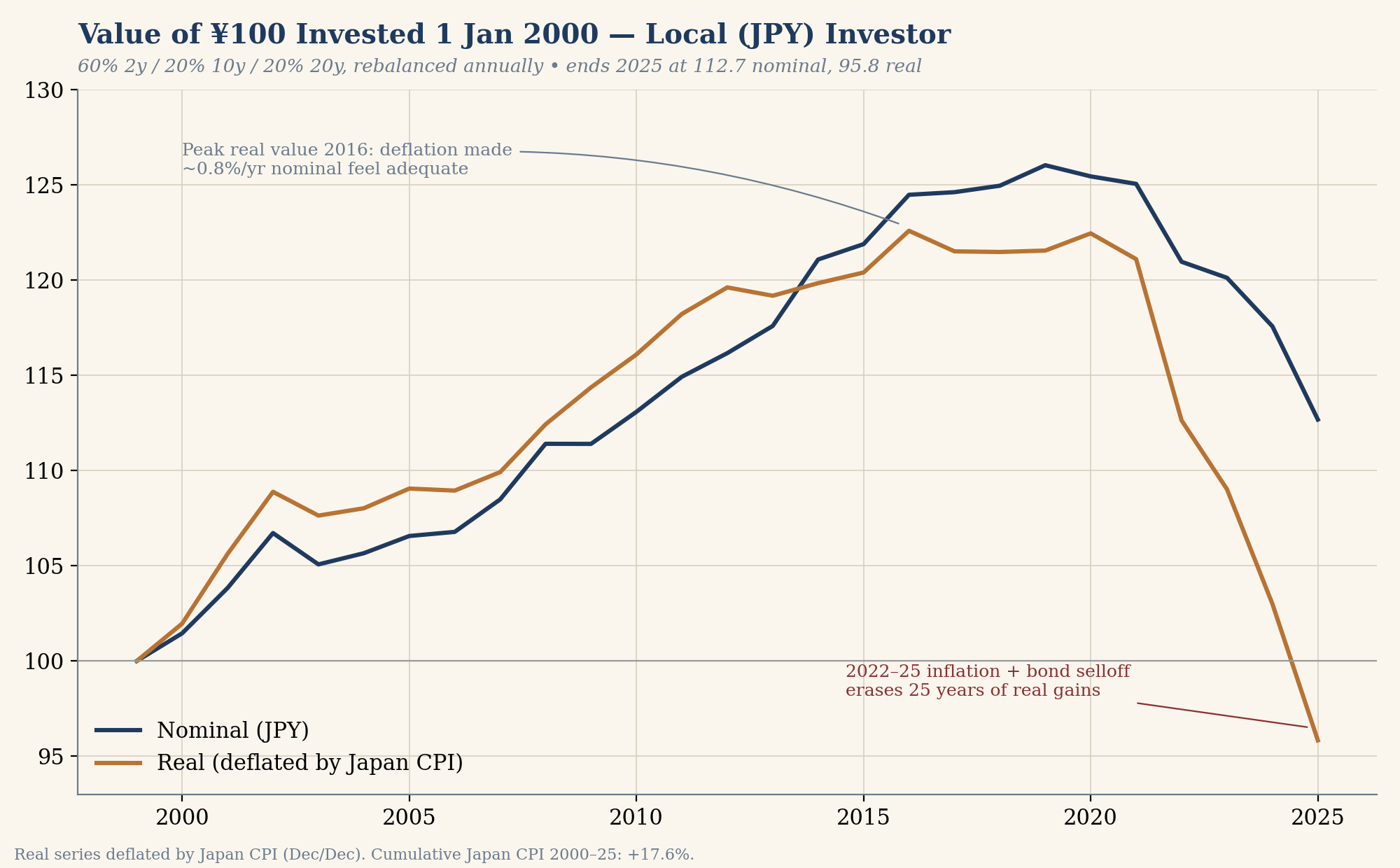
Mapping the value of the ¥100 over the course of the journey, investors’ real value peaks at ¥120, hardly spectacular, but again it’s ok. Some five years later it’s negative. Twenty-five years of lending to the government and collecting at maturity has meant real loss.
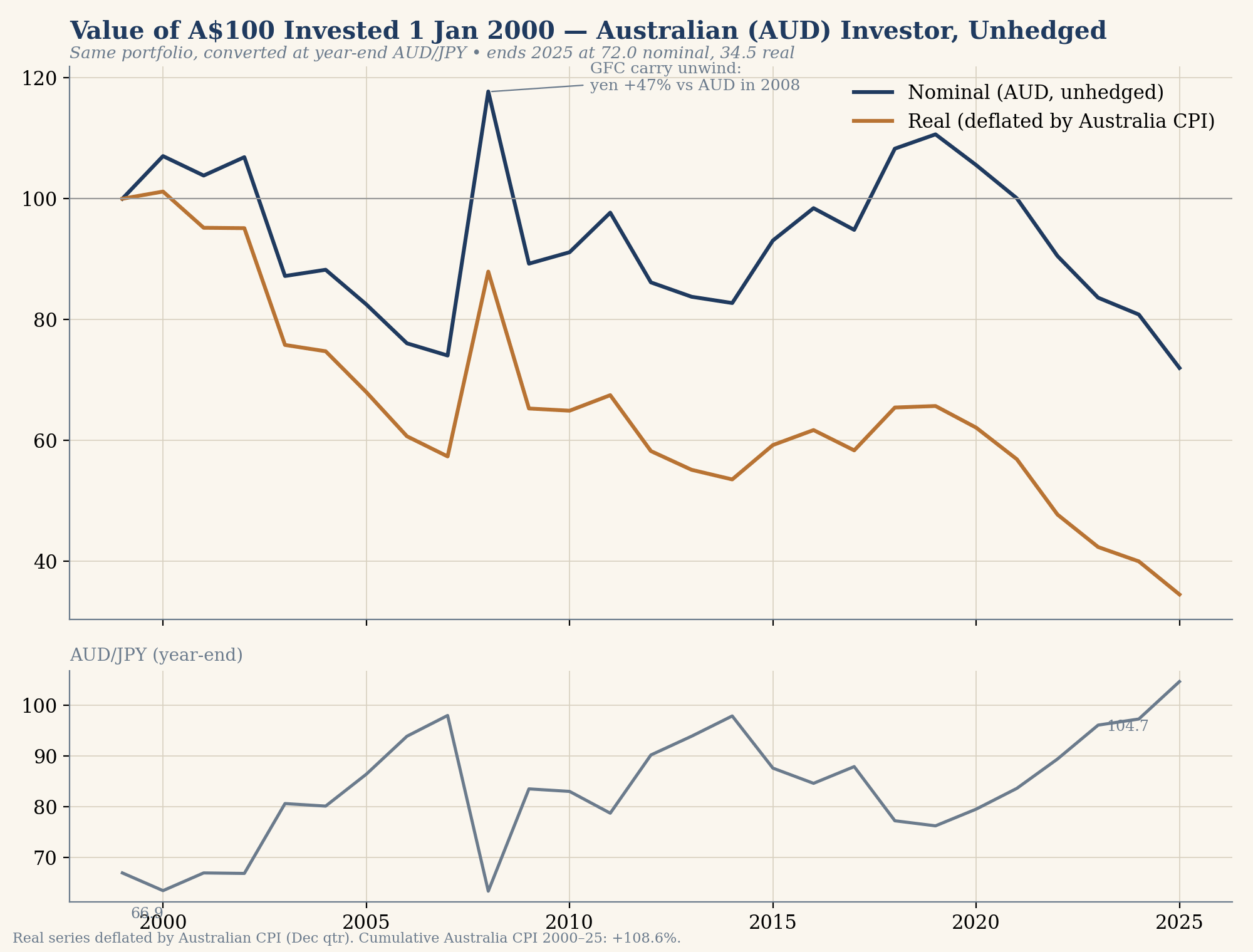
The real pain though is via currency. Simply printing a lot of currency to buy your own bonds destroyed the value of the Japanese yen. That process began almost immediately. Any Australian investing money in Japanese bonds has consistently lost money in AUD, nominal, real, cut it any way you like, it’s been a losing trade.
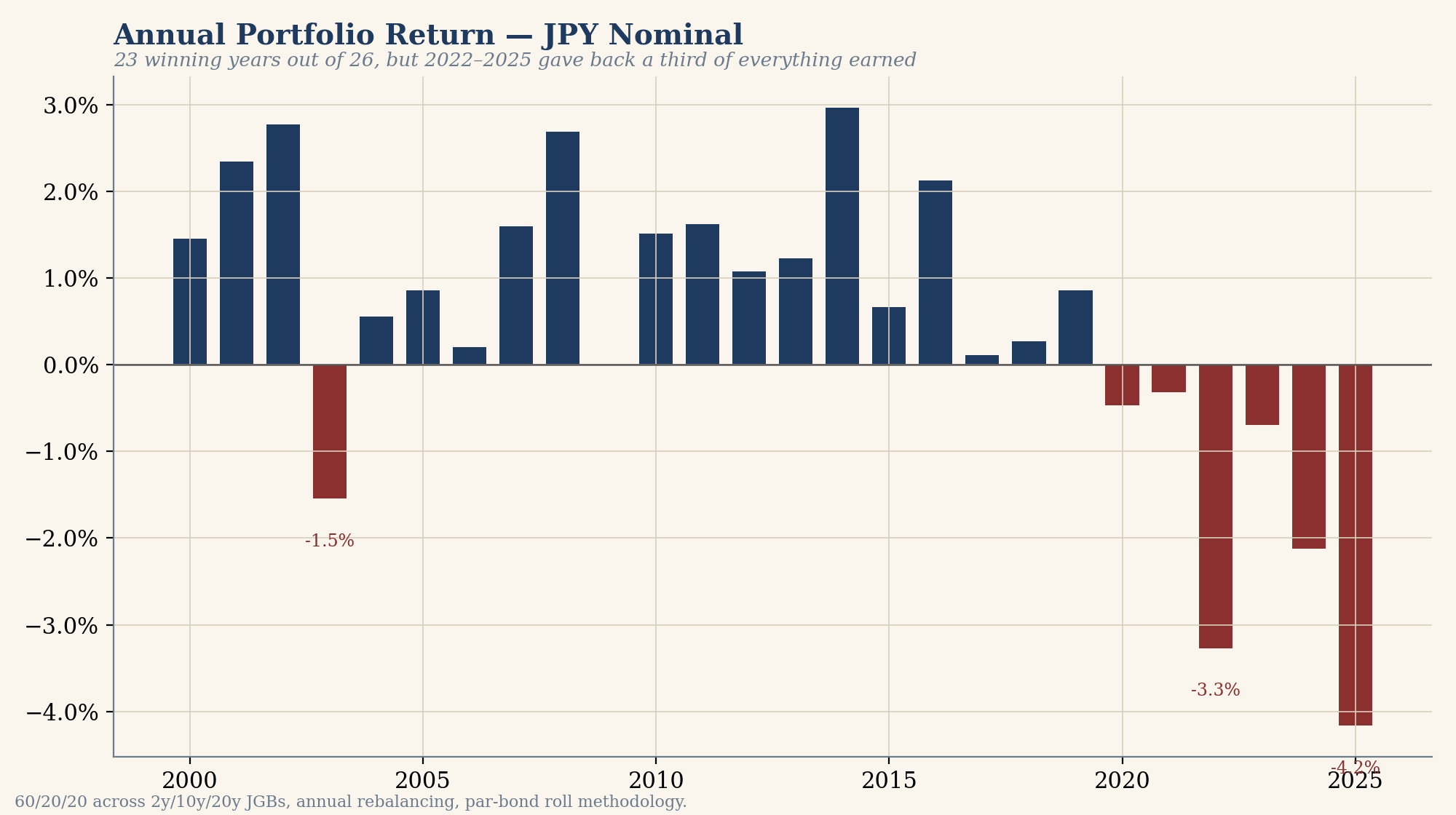
So a local Japanese investor might have been fine with the 20 years averaging just over 1%, but recently it all got wiped out.
It’s far worse for an overseas investor though. Their value is absolutely destroyed from the very beginning. Indeed the impact of the UK’s decline is not as apparent to people until they go overseas, when they are astonished at the cost of everything.
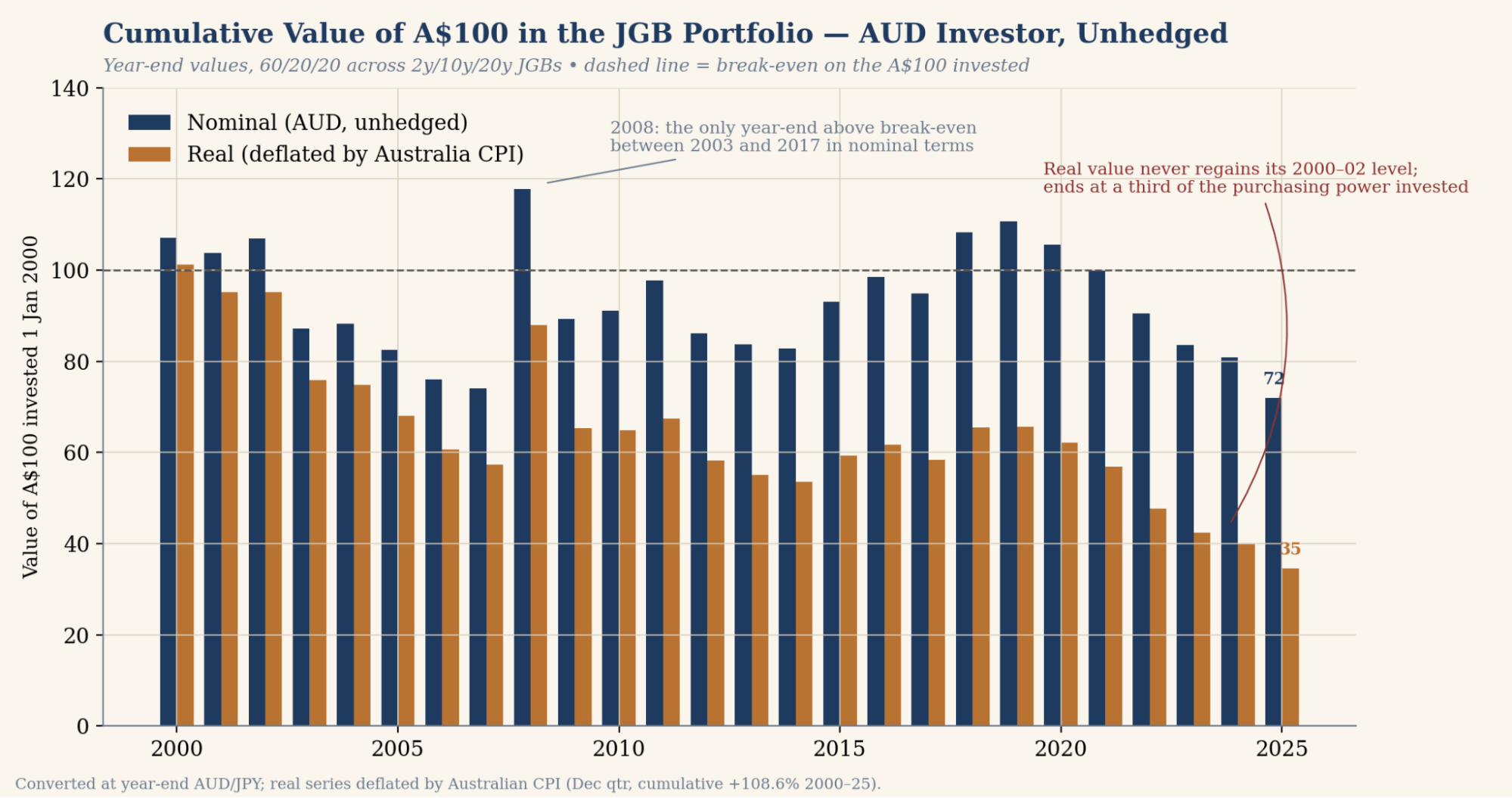
In cumulative terms, an Australian investor with $100 at the commencement of this trade now has $72. In real terms they have $35. It’s extraordinary really that lending money in a fairly conservative way to the world’s second largest economy could result in outcomes like this, but it has. When the simulated trade began, Japan was the second largest economy in the world. Now it is fourth, behind Germany. So it is still a hugely productive and successful country. Bonds, in my view, remain an absolutely terrible investment. They will continue to have single stand out years but the only people that make money from them are the people selling them.
The good news from all this is the very clear signal. The UK is completely uninvestable, the EU also. There is no apparent change in the business outlook in either location at present that would suggest the tide is turning either.
There are alternative views on this. UK private bank Coutts put out a note in June about the performance of bonds over time which is worth a read. It conveniently ignores the value of the pound though which I believe has only one direction now over the next decade.
More than anything though, it’s not so much the performance of the bonds but the currency of the issuer that matters. Most fiat currencies look toxic but the pound and the euro look the sickest of all to me.
Railway
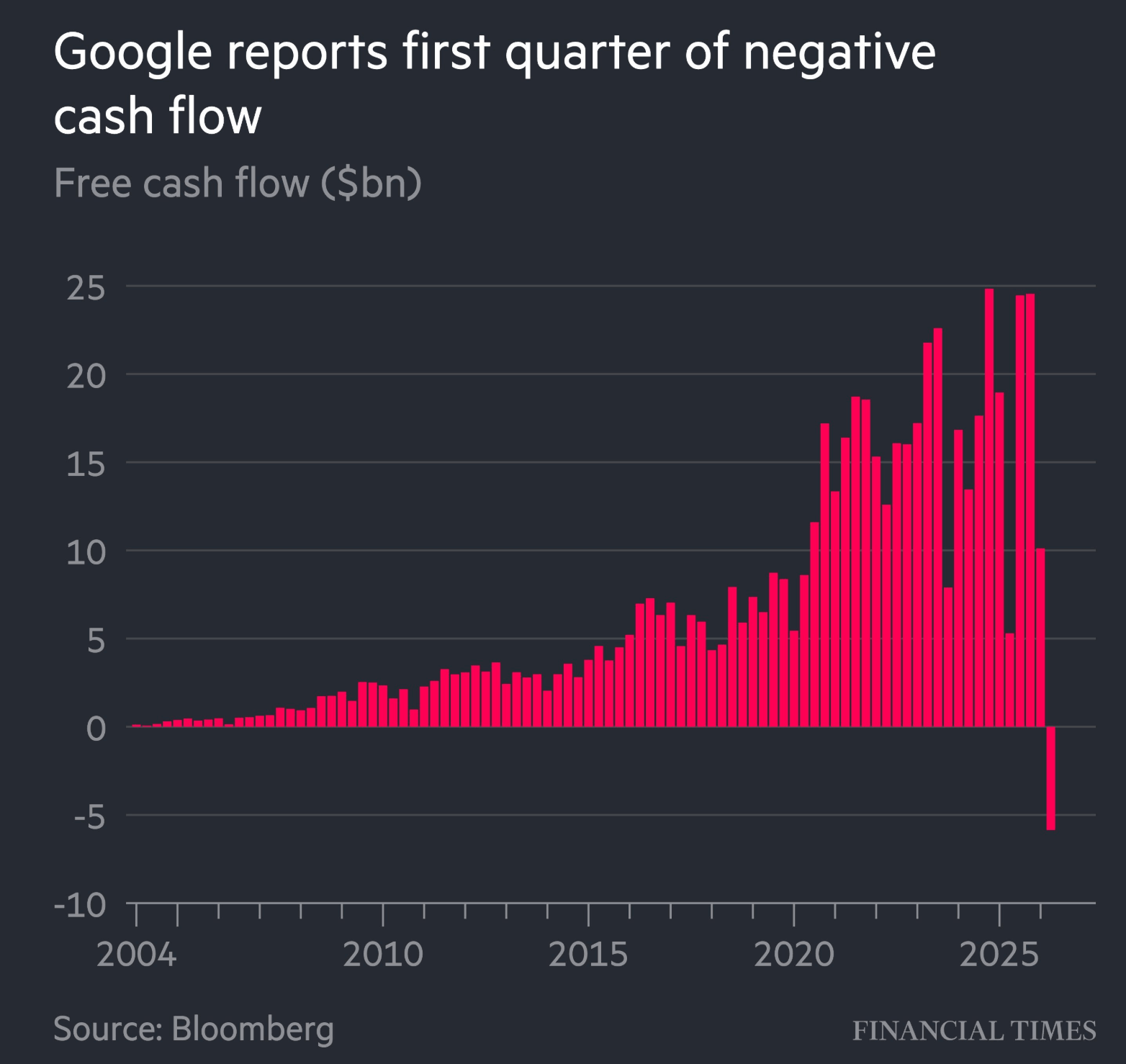
Google has never had negative free cashflow, ever. Until last week. The revelation caused their shares to produce the worst daily performance in years. 18 months ago, Sergey Brin promised that he would ‘bet the house’ to win the AI race. Surprising then that the market reacted like it did to him delivering on the promise.
Google is not Anthropic or OAI though. They have their own chips, their own models, their own cloud and they are training specifically for efficiency per task. Most people do not drive a Ferrari, most of the world’s work will not be done by a frontier model either.
The real juice will be in the infrastructure and the cheap model that does the normal thing for very low cost. I think the odds of Google winning that battle are high. As we stand today they do not have a frontier model in the market (because they arguably could not serve it at the capacity it would be used).
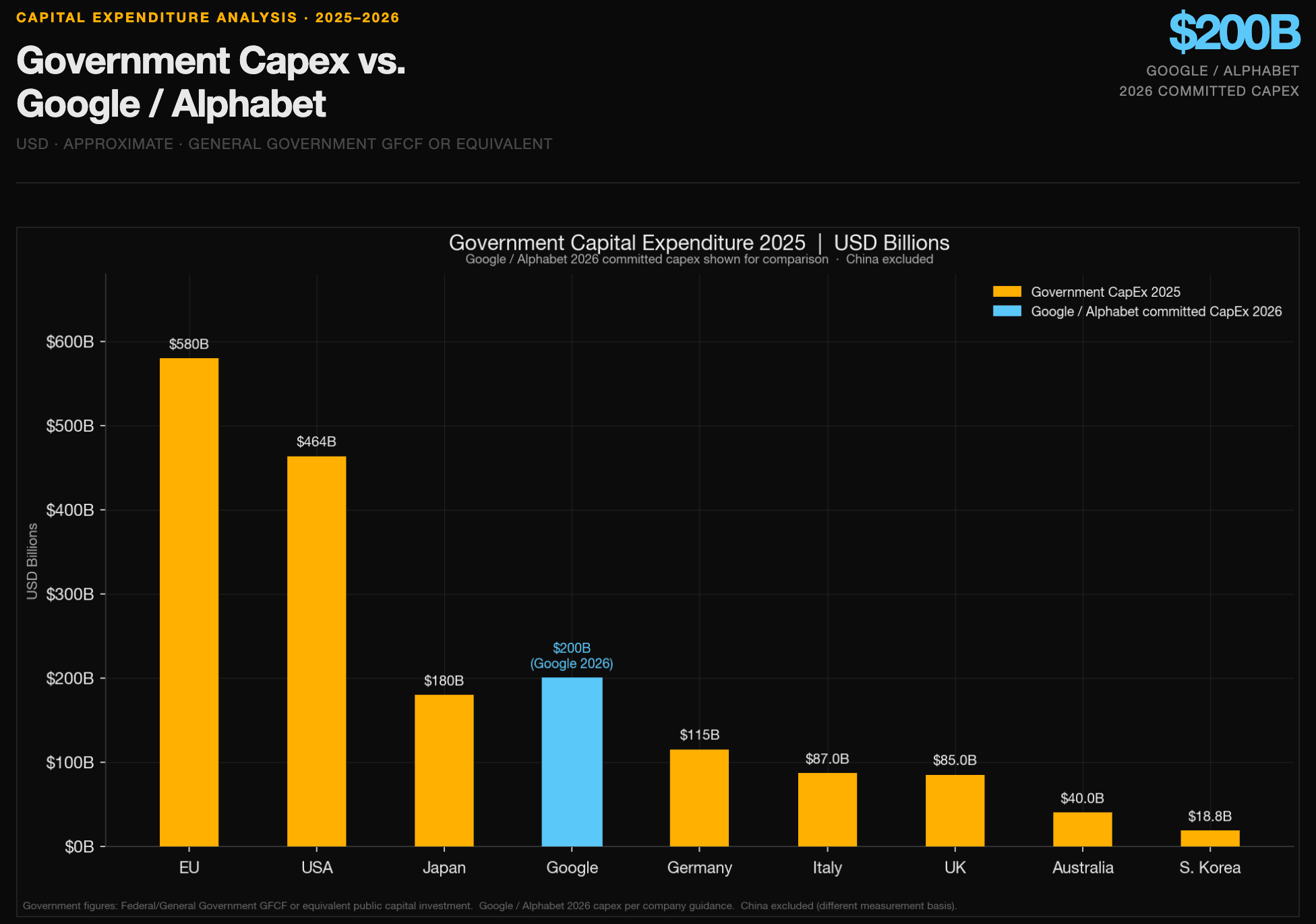
There is something more exciting about the cash pivot though. The UK government spends US$85 billion per annum on capex. Railways, defence, whatever else. The Australian government spends about $40 billion. Google is spending about $200 billion in 2026, with estimates that this will rise to over $300 billion in 2027. That is one company now spending at a rate that exceeds most nation states. It truly shifts the dial too about where power lies. The people with first access to the AGI-intellect will be private companies, not governments.
This has happened before, first with railroads when the private sector outspent governments routinely. Next came electrification and power grids. There was a similar trend with internet fibre but it was not remotely at this scale. In any event, what it tells us is this is no ordinary trend.
The next wave of ultra-capex is upon us. The stock prices of the hyperscalers are being punished for it too but in five years’ time, such is the pace of change, they might be the only show in town.
Euro-Trash
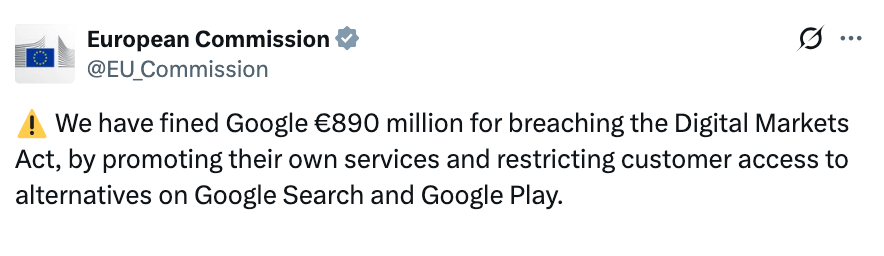
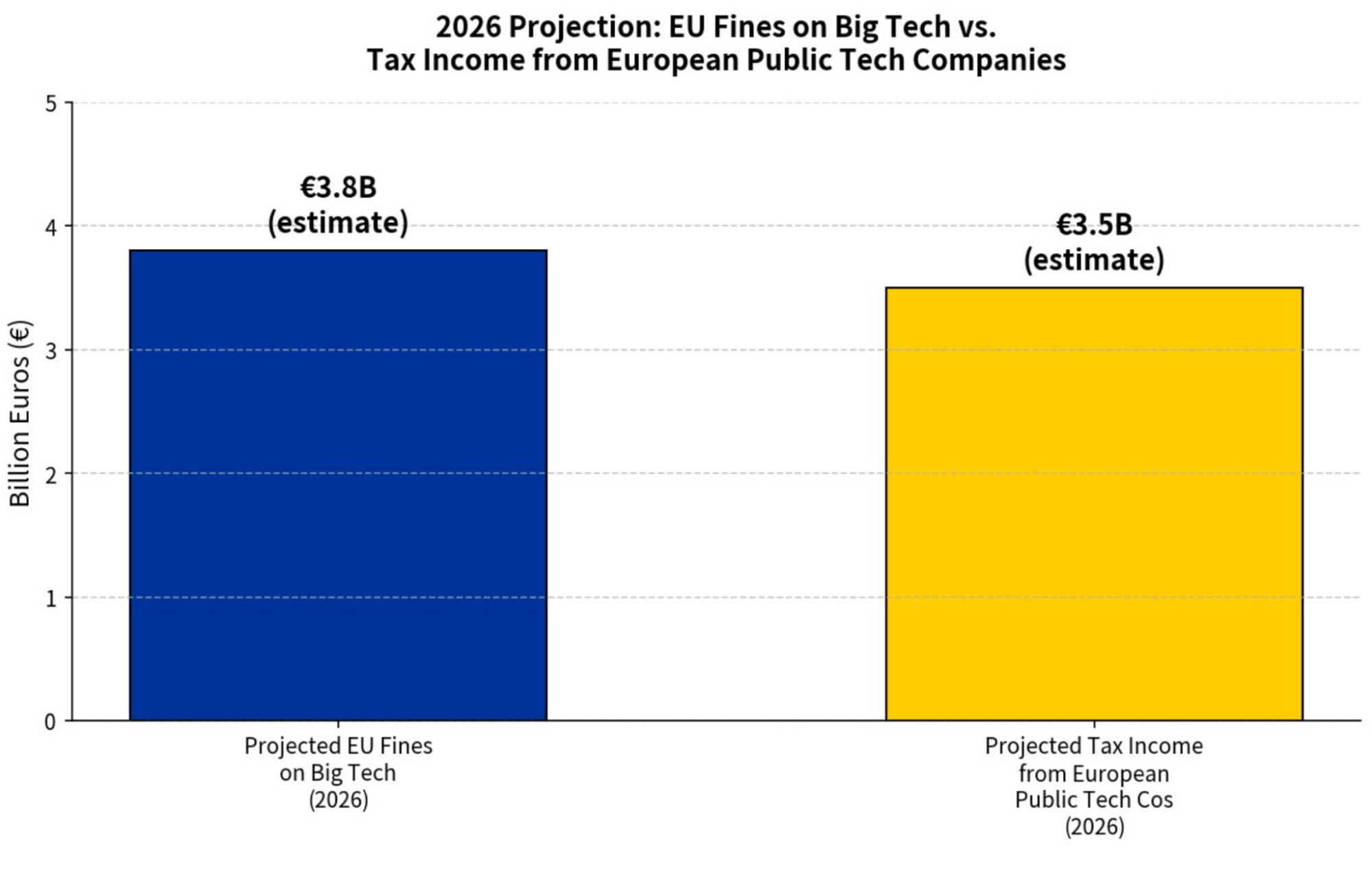
Can you hear the cheering from Brussels? A near $1 billion fine for one company. The chart is only a projection but we are on track once again for the EU raising more revenue from fining US companies than they make in tax from their own tech sector.
Google’s crime is the same as Apple’s crime. They do not make it easy for competitors to interact with their ecosystems. Rather like a foreigner trying to do business in Europe then.
